Showing posts with label the garden. Show all posts

Monday, February 27, 2012

About three months with no posts..

It is hard to believe that it is about three (3) months since my last post.  I am not going to make any excuses  - all I have to say is that we needed a break.

Our journey toward sustainable living as a family of five has in no way stopped or been put on hold - below is a snapshot of some of our activities over the past three months.

We have started a local wholesale buying group.....


We have been making our own sourdough bread from home milled grain for nearly 6 months now and have preserved about half of a 5 kg box of garlic grown by my uncle.  We have enough great Australian garlic to use for a year and some to get planted in the garden soon. 


Our work at the ELF Community Garden continues (visit our Facebook page for more information and photos)


Our home garden has been producing lots of fruit, picking greens and vegetable over summer...


And, of course we found some time to connect with nature and enjoy the outdoors. These are some snapped of the kids enjoying time at Ganguddy Camping Ground (Dunn's Swamp) Wollemi National Park.


And that's just a taste of what has been happening.... I am looking forward to sharing our continuing journey to sustainability.


Tuesday, November 22, 2011

Our wetland is filling in this week of rain

In a Permablitz on our front yard in October 2010 we constructed an ephemeral wetland (or dry creek bed) in our front yard native plant section.  The photos below shows how it has developed over the last year - I think it should be inspiration enough for anyone to make their own wetland - dry creek bed.  We are now waiting for the frogs to find our secret wetland and make it home.

Building the dry creekbed / wetland October 2010

After rain - November 2010

Putting native pine mulch up to the edge of the creek / wetland  April 2011

The wetland now after naturally filling with rain - November 2011

Have you ever been inspired to include a wetland in your home garden?

Friday, October 21, 2011

Using old bath tubs to make wicking beds

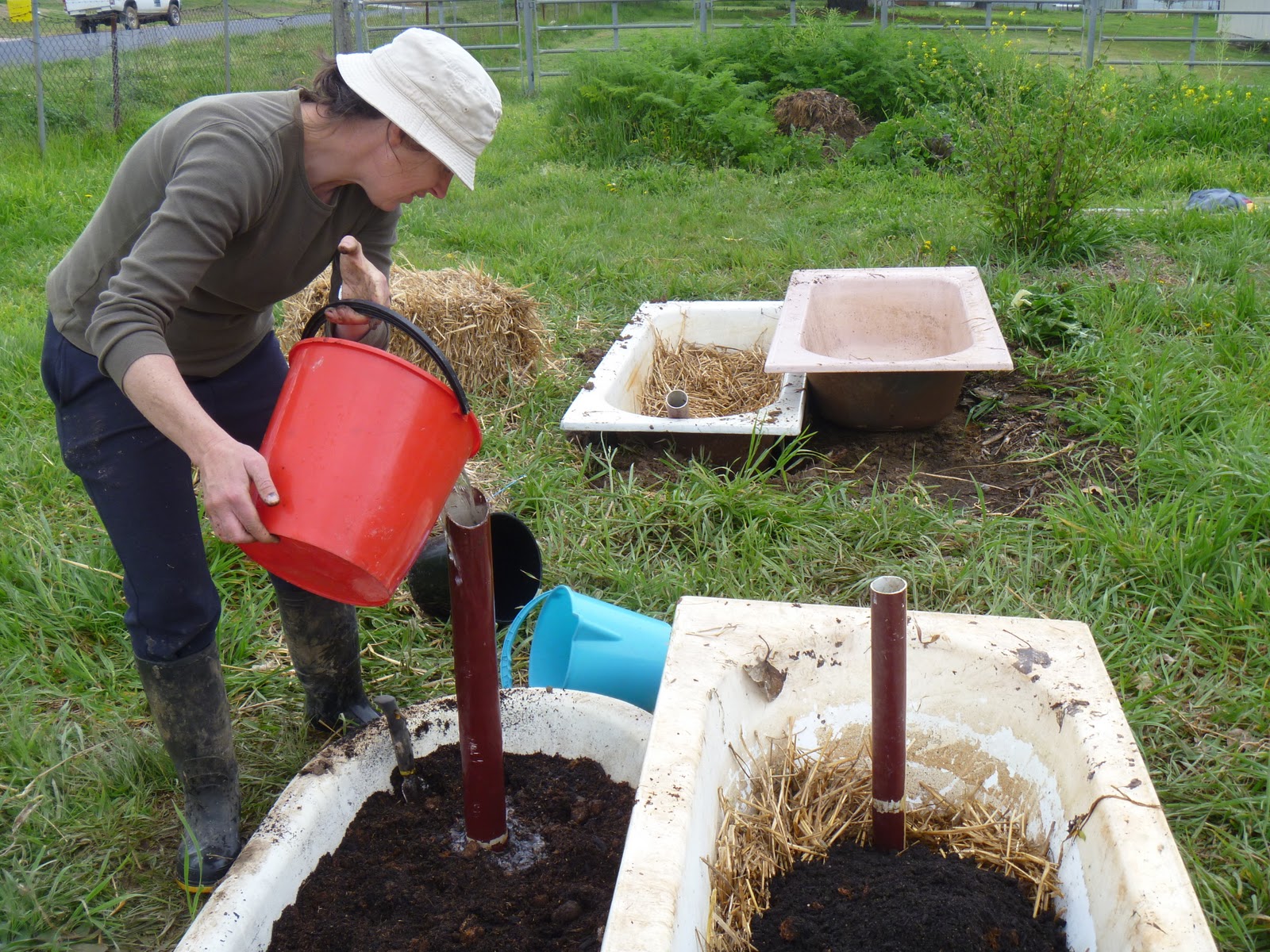
At the Orange community garden working bee a weekend or two ago we constructed some bathtub wicking beds.  Over at Child's Play Permaculture there is a good article on wicking beds if you would like more information but here is a few snaps of what we did on the day.

Placing the bathtubs in position... we had to level the sites out a bit and sink the northern tub
in lower than the southern one. The idea being that the northern tub will shade
the side of the southern (back) bathtub and stop it from heating up too much.
Some old downpipe was recycled as the watering for the wicking bed.  Pipe ran flat along
the bottom of the bath and had slits cut to allow water to run out into the bottom of the bath.

After adding and wetting the wicking layer of straw we filled the baths
with some good garden soil.
Testing the wicking pipes.

Now for some seedlings - lettuce in the front bathtub.

Taller plants in the back tub (sweet corn at the moment - we might plant some
beans and cucumbers in here at the next working be).

Can't wait to see how they are coming along.... might have to visit for a quick peek on the weekend.

Sunday, October 2, 2011

Medicinal herbs in our local park

Last weekend we had the opportunity to tag along with a tour of our local Cook Park looking at medicinal herbs and their uses.  The tour was part of the National Herbalists Association's National Herbal Medicine Week and was lead by local herbalist Angela Duncan.


We all certainly had fun walking along and exploring what was in our local park and learning more about what some of the uses of the herbs were.

Some plants that I would like to get into our home garden include Yarrow and Wormwood.  I learnt that the nerve toxin drug absinthe was made from Wormwood (Artemisia absinthum) but also that wormwoods have great anti-inflammatory properties - as well as being useful for repelling pests such as lice and intestinal worms around the chookpen. I feel that I have so much to learn about various uses of herbs - many of which are common in our everyday gardens such as rosemary and willows (the active ingredient of Asprin is based on the active ingredient in Willow Bark).  Of course, many of these herbal medicines need to be taken in tablet form under the guidance of qualified herbalists to ensure correct dosage and usages.

The kids also enjoyed some time in the park at Spring time.


Wednesday, August 3, 2011

National tree day planting missed..

We got caught up with things on Sunday so came in late for the National Tree Day planting at our local urban wetland - much to the kids disappointment all 1,000 trees were planted before we got there.  What a great result - but the kids were geared up for tree planting and therefore very disappointed.  So we came home and planted about shrubs and grasses in our front garden - our natural area.


Wednesday, June 1, 2011

Increasing perennial vegetables in our garden

Since studying Permaculture last year we have been trying to increase the number of perennial plants in our vegetable garden.  Over summer this year we trialled a new perennial root crop - Yacon.

Yacon or the Peruvian Ground apple is a close relative of the Jerusalem Artichoke - it is a member of the Asteraceae or the daisy family.
 
Jerusalem artichoke
Yacon
Yacon produces two types of tubers - the purple - red bumpy tubers that are close to the surface - these are the tubers that we will be storing in a cool dark place in coir peat until spring planting time to produce more Yacon tubers to harvest next year.

Under the purple - red tubers are bigger more smooth tubers - these are the ones that you eat.  We planted only a single tuber this year and harvested all these edible tubers.

Our Yacon harvest - from a single tuber.


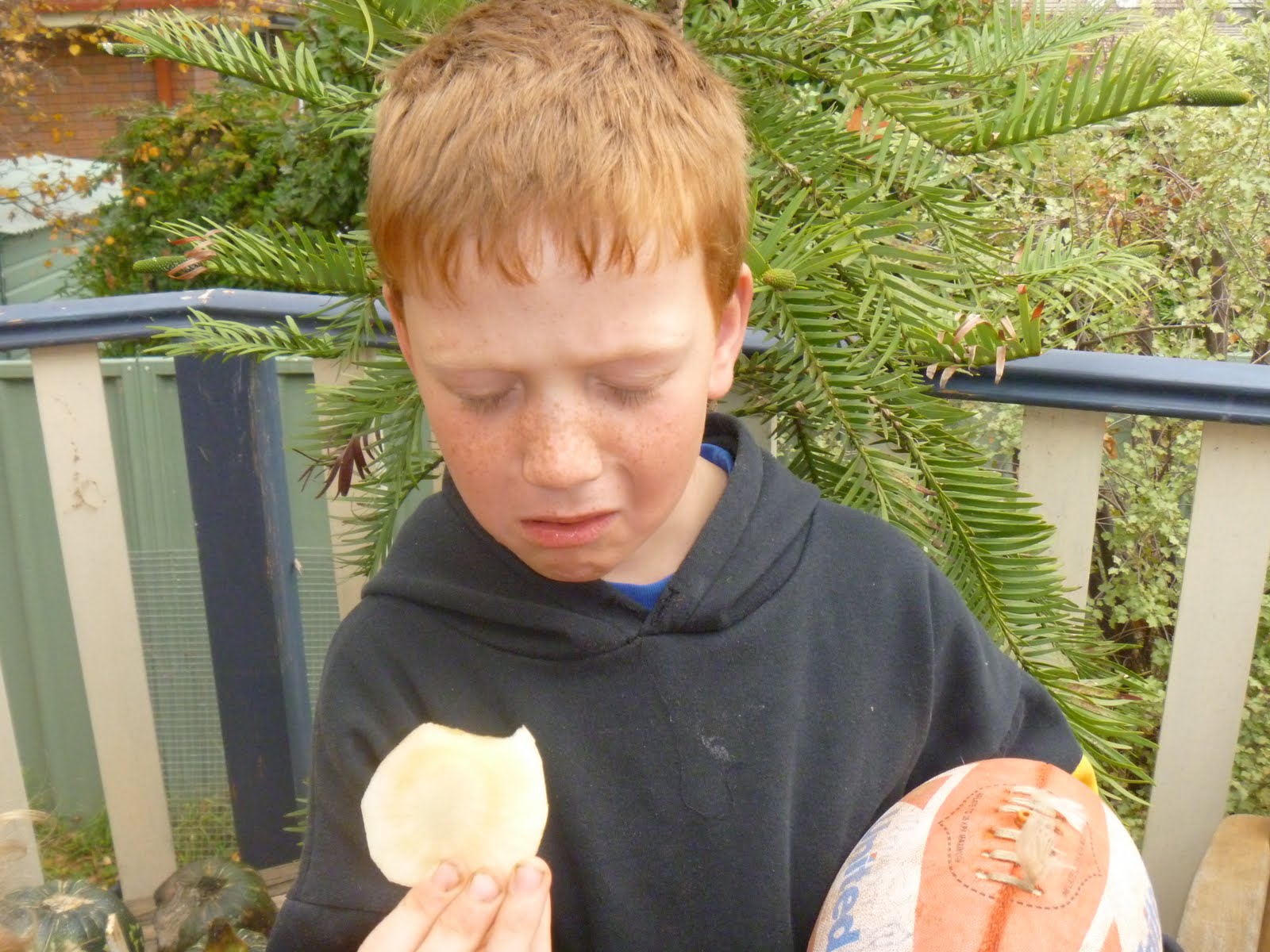
Tasting our first Yacons

Yacon passes the first taste test
...but not the second!

I must admit the taste is unusual - an apple flavoured potato  - is one of the best descriptions I have heard.  Truly unique when eaten fresh but as a roasted vegetable it is great.

Roasted vegetable - potatoes, carrots, pumpkin and Yacon.


Saturday, May 14, 2011

Our first taste of winter

With the start of the winter soccer season our weekends have been taken up with soccer - 4 games on Saturday and 2 out of town games on Sunday.

Just as soccer has started so too has the cold weather - including our first good frosts....


And even got our first dusting of snow.....


One thing that is apparent with our first cold snap is that the plants we have along our northern brick wall are showing no signs of frosting .... the photo below was taken on the same day as the one of the nasturtiums and brussel sprouts were covered in ice in the photos above. I am keen to monitor this micro-habitat into the full depth of winter.


Sunday, April 24, 2011

Grammas, pies and much more

We spent some of our days in the holidays working on our food forest patch in the front yard.  Cleaning up, weeding and pulling out the old pumkin vines - and we found all these.


Our Gramma pumpkin harvest.  These Grammas have a thin wall and will not store well so we have to begin using them before they go off.  The biggest gramma in the forground split when we picked it - so we have to eat it now.

So a first for the season was a Gramma pie - made with a mix of recipes to match a favourite the description of Dad Grandmas pie.  The verdict being that it was maybe even better than Grandma's.


Our Gramma Pie recipe for those that have started their pumpkin or Gramma harvest and would like to give it a try.

We used about one quarter of our large Gramma (because it is not too sweet or strong in flavour) pumpkin for this recipe - but a slightly green butternut pumpkin would also work well. 

Cook about 1 kilo or gramma in a little water for half an hour - once cooked. Drain and gently squeeze / squish to remove excess fluid.  Mash with a fork and add 1 1/2 cups sugar, juice and grated rind of 1 lemon, 1/3 cup of sultanas, 1 tablespoon of brown sugar and 1 teaspoon of each nutmeg and cinnamon.  Mix and allow to cool.

To make the pastry, rub 150 grams of butter into 1 cup of each plain and self raising flour with a pinch of salt.  In a cup mix one egg with 2 tablespoons of sugar - add to flour / butter mix.  Mix well - add a little milk if necessary - roughly kneed the mix together and divide the dough into 2/3 and 1/3 portions.  Roll out the 2/3 portion of pastry to line the base of a greased pie dish - add the Gramma filling, and then roll out the last 1/3 of the pastry for the lid of the pie. Sprinkle top of pie with a little more sugar. Cut a breathing hole in the top of the pie. Bake in a moderate oven for about 1 hour.

Serve with ice-cream and / or cream. Enjoy - we did.

With only 1/4 quarter of the pumpkin used it was roast pumkin for the Sunday roast and now a large pot of pumkin soup is brewing.  And still half the pumpkin left.


What are your favourite pumpkin recipes? 

We still have a pile of Grammas to eat and more pumpkins to be harvested from the back yard - so I would love to hear what you do with your pumpkin harvest.

Tuesday, April 5, 2011

Enhancing our native section of the garden

It was the Friends of the Orange Botanic Gardens Plant Sale day on Sunday.  We went down and got some native plants for our front garden - a few different Correa species, a BlackWood (Acacia melanoxylon), some local Hibbertias (Guinea flowers), a Tea tree and a Swainsona pea.


We planted them on the same day - along with all sorts of left over native plants I have had in the hothouse over the last year.  I am hoping that these plants will have a month or so to establish before the Orange winter sets in.

This all helps to make our "wildlife garden" or zone 5 on our Permaculture design for our suburban block.


It is going to be so nice to have our own "bush" in the front yard - soon we will have frogs and birds right outside our windows.  Our littlest is also keen to go "bushwalking" in the front yard.

Monday, February 28, 2011

Testing the powers of vinegar outdoors

It's been a while since I started using vinegar as a cleaner indoors in the kitchen and bathroom - and I am totally converted.  Vinegar is a great glass cleaner, helps remove those stubborn stains around the stove and on the kitchen bench.  Vinegar cleans our stainless steel appliances (fridge and dishwasher) - getting rid of those little kids fingerprints and leaving a clean streak free surface.

A few weeks ago I read a snippet somewhere that vinegar can be used as a weed spray outdoors. Having found uses for vinegar indoors I could not wait to trial vinegar in the outdoors.  Further research on the Internet brought up numerous articles on vinegar (or acetic acid) as a herbicide - read some here and here and here

So here is our home trial of vinegar as a herbicide and the results we have observed so far.

I filled a pressure spray pack with 2 litres of vinegar (just the cheap white vinegar) and added a small squirt of dishwashing liquid (to help get better leaf coverage) and went out to the front yard to trial my new herbicide on cat's ear,  paspalum, couch and dandelions (photos in this order).

The photos on the left show photos of the weeds at the time of spraying and the photos on the right are the same plants just 2 days after.


The results look promising.

Vinegar (or acetic acid the main chemical in vinegar) acts as a drying agent on the leaves of the plants.  You need to apply the vinegar on a warm sunny day to get the best effect (or the best drying out) - and the leafy plants like the dandelions showed signs of drying out almost immediately.  Even the grasses (paspalum and couch) are showing signs of being weakened.  Vinegar is a broad spectrum herbicide so you need to be careful with your spraying - spray only the plants you want to kill and do not spray on a windy day.  Vinegar is not as powerful as commercial broad spectrum herbicides- and you should expect to have to reapply your treatment several times.

I am inspired by my initial results and will keep repeating the vinegar applications on our next sunny day to keep weakening the weeds and hopefully eventually eliminate them from this section of our garden.